
A Colour and Mood Board Checklist to Run Through Before You Commit
Before you settle on a palette for your recording space, work through these checks on guests, topic, camera and light, so the board you choose still looks right on screen.
Start with who sits in the chair
A palette that suits you may not suit the people you invite. Before you pin a single swatch, list your regular guests and think about what they usually wear. A guest in a deep navy jacket against a charcoal wall disappears into the background, while the same jacket against a soft oatmeal panel stands out cleanly.
I ask learners to write down three typical guests in a sentence each: age range, usual clothing, skin tone as seen on camera. It sounds fussy, but it stops you choosing a board that only works for one person. If your guests vary widely, aim for a mid-tone neutral that gives contrast to both light and dark clothing.
Also note whether you record alone, in pairs or with three people, since a wider shot shows more wall and asks more of your colour choices.
- List three typical guests and their usual clothing
- Note whether the shot holds one, two or three people
- Choose a mid-tone backdrop if guests vary widely
Match the board to your topic
A mood board should say something quiet about what you talk about. A show on gardening or home cooking sits comfortably with warm clay, sage and natural wood. A show on finance or local policy may want calmer stone greys softened with one warm accent so the frame does not feel cold.
The check here is simple: look at your board and ask whether a stranger would guess the tone of your show from it. If the board feels playful and your interviews are serious, one of them needs to change, and it is usually easier to adjust the board.
Keep the topic in mind when you pick your accent colour too. One accent, used in two or three places, is enough. A board with five accents tends to turn into clutter once real objects are placed in the room.
- Ask whether a stranger could guess your show's tone
- Limit yourself to one accent colour
Test swatches against your camera
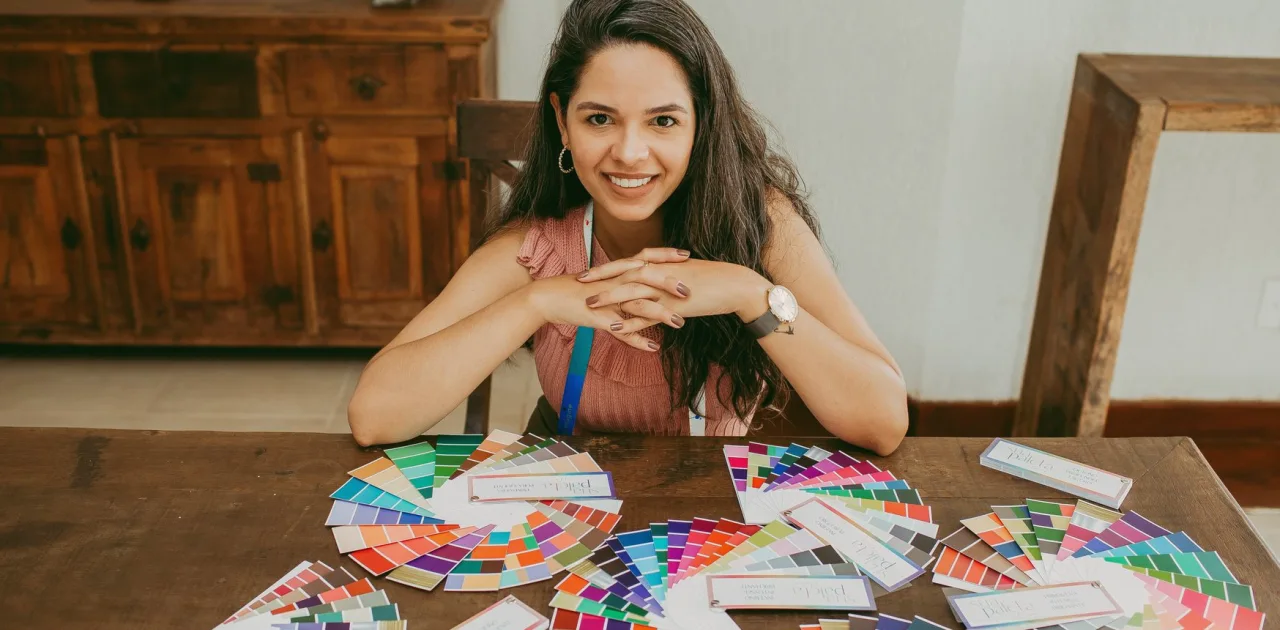
Colours on a screen, on paper and through a lens rarely agree. Before you commit, hold your physical swatches in front of the camera you actually use, in the room where you actually record, and look at a frame grab rather than the live preview.
You will often find that a cream looks yellow, a grey looks blue, or a rich terracotta turns orange. Note which swatches stay true and which drift. This is the most useful ten minutes in the whole colour module, because it replaces guesswork with something you can see.
Take the test at the hour you usually record. Morning window light and evening lamp light can push the same paint in different directions, and a board that only works at noon will let you down on the days you record late.
- Photograph swatches with your own camera
- Compare a frame grab, not only the live preview
- Test at the hour you normally record
Check the light before the paint
Light is the quiet partner of every colour decision. A north-facing room tends to cool everything down, so warm neutrals earn their place there. A room with strong afternoon sun may bleach pale colours, and a slightly deeper tone will hold up better.
Walk your space and note where light comes from, what colour your bulbs are, and whether anything reflects onto the wall behind the speaker. A green sofa just out of frame can still cast a tint on a pale wall.
In these autumn weeks the daylight is lower and softer, which is a good moment to see how your palette behaves in the dimmer months. If a board looks right in October light, it will usually survive the rest of the year.
- Note window direction and bulb colour
- Look for reflections from objects outside the frame
Edit the board down to what will fit
A board full of lovely images is not yet a plan. Go through it and remove anything you cannot realistically place in your room: the large velvet armchair that does not fit, the full-height shelving your wall cannot take.
What remains should be a short set of colours, two or three textures and a handful of objects. Each item needs a reason to be there. If you cannot say why a ceramic vase is on the board, it is decoration for the board, not for the frame.
Compare the edited board with your room photographs and measurements from the earlier module. If the two feel as though they belong together, you are close. If they argue with each other, adjust the board rather than the room, at least for now.
- Remove anything that will not fit your room
- Give every item a stated reason to be in shot
Decide what you will hold off on
Not every choice has to be made the same week. Paint, fabric and large furniture are costly to reverse, so test them with swatches, borrowed cushions or a hung sheet first. Small items such as books, lamps and plants can be swapped freely and are a safer place to experiment.
Write a short list of decisions you are confident about and another of those you want to test. Confident choices move on to the layout plan. Tested choices stay on the board until you have seen them in frame at least twice.
This habit keeps the process calm. You are not trying to get everything right at once, only to avoid committing early to the one thing you cannot easily undo.
A mood board earns its place when it has been checked against your guests, your topic, your camera and your light, and then trimmed to what the room can hold. Run through these questions once, write down your answers, and keep the list beside the board. When the answers agree with each other, you are ready to move on to the layout plan with a palette you can trust.
Keep reading
-
Two Chairs, One Awkward Gap: A Furniture Placement Case
Nadia hosts a weekly interview show from a narrow spare room. Here is how moving two chairs, not buying new ones, changed how she and her guests look on camera.
-
Common Mistakes in Colour and Mood Boards, and How to Avoid Them
Priya Nair walks through the slips that most often weaken a mood board for interviews and streams, from crowded swatches to ignoring the camera, and how to correct each one.