
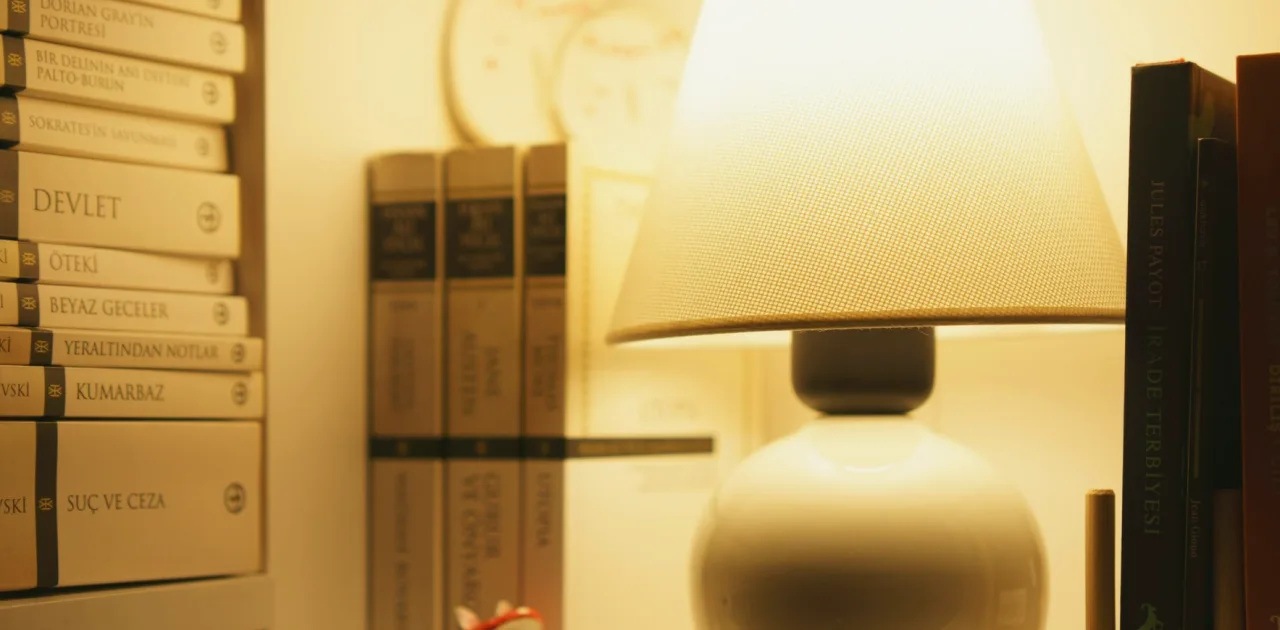
Autumn Props: Choosing Objects That Earn Their Place in Frame
As the light turns warmer and rooms feel cosier, this is a good moment to review the books, plants and lamps behind you and keep only what has a reason to be in shot.
Why autumn is the right time to look at your shelves
When the evenings draw in, many of us start recording under lamps rather than daylight, and the objects behind the speaker suddenly look different. A shelf that seemed balanced in summer can read as flat or cluttered once the light turns amber and the shadows lengthen. That is why I like to schedule a props review in these weeks, before the busiest stretch of interviews and streams begins.
Start by sitting where your guest will sit and looking at the frame on a monitor, not with your own eyes. The camera crops, flattens and exaggerates. Items you stopped noticing months ago, a stack of mail, a charger, a mug, become the first thing a viewer sees. Treat this as a fresh look rather than a clean-up, and write down what you notice before you move anything.
- Review the frame on a screen, not in person
- Sit in the guest's chair for the check
- Note what you see first before touching anything
Give every item a reason to be in shot
The simplest test I teach is a single question: why is this here? A book can be there because it relates to your topic, a lamp because it adds a warm pool of light, a plant because it softens a hard corner. If the honest answer is only that it was nearby, it can go back to a drawer. Props are not decoration for its own sake; they quietly tell viewers who you are and what the conversation is about.
Keep the reasons modest and visible. Three or four objects with a clear purpose will always look calmer than a dozen with none. Group them by purpose rather than scattering them evenly, so the eye finds a small area of interest and then rests. Empty space on a shelf is not a gap to fill; it is what makes the objects you chose look intentional.
- Ask why each item is there, and remove the ones with no answer
- Aim for a few objects with clear roles
- Leave deliberate empty space around them
Seasonal touches that stay quiet
Autumn invites small changes, and the key word is small. Swap a bright green plant for one with darker foliage, or replace a pale ceramic piece with something in a rust, clay or soft brown tone that sits close to your wall colour. These shifts echo the season without turning the set into a themed display. If a viewer notices the change consciously, it has probably gone too far.
Avoid anything that dates quickly or competes with your face. Loud seasonal decorations, strong patterns and shiny surfaces pull attention sideways, and glossy objects catch lamp reflections that are hard to remove later. Choose matte finishes, natural textures such as wood, linen and paper, and colours that sit within the warm neutral range of your palette. Then the set can stay up through the whole season.
- Pick matte, natural textures over shiny ones
- Stay close to your existing warm neutrals
- Skip anything that competes with the speaker
Lamps and the new evening light
A practical lamp earns its place twice: it lights the scene and it shows in the frame as a warm point of colour. As natural light fades earlier, check where your lamp sits relative to the speaker. Placed slightly behind and to one side, it adds depth to the background. Placed in line with the camera, it flattens everything and can create a hot spot on the wall.
Test the bulb as well as the lamp. Mixing warm and cool bulbs in one frame gives skin and walls an uneven cast that looks odd on video. Pick one colour temperature for everything visible and keep the shade clean and simple. Dim the lamp until it glows rather than glares, and look at the monitor again, because a lamp that feels comfortable in the room can read much brighter on camera.
- Place the lamp behind and to one side of the speaker
- Use one bulb colour for everything in shot
- Dim it until it glows instead of glares
Books, plants and the problem of repetition
Books are the most common prop and the easiest to overdo. A full wall of spines creates busy vertical lines that distract on camera. Pull a few out, stack some horizontally, and let a small object sit on top of the stack. Turn spines that carry bright lettering to the back or choose covers in quiet tones. Only keep titles you would be comfortable having a viewer read.
Plants need the same editing. One healthy plant with an interesting shape does more than three tired ones. Check that leaves do not touch the speaker's head line, and rotate the pot so the best side faces the lens. As heating comes on in autumn, watch for drooping or dust on leaves, since the camera will find both. Repeating the same shape or colour twice in the frame gives a pleasing rhythm; repeating it five times becomes pattern.
- Mix vertical and horizontal book stacks
- Keep one healthy plant rather than several tired ones
- Repeat a colour or shape twice, not five times
A short routine before each recording
Props drift. Objects get moved, borrowed and replaced between sessions, so a quick routine keeps the frame consistent. Take a reference photo when the set looks right and keep it somewhere easy to find. Before each recording, compare what you see on the monitor to that photo and put anything out of place back where it belongs.
Finish with a thirty-second check: look for shine, stray cables, crooked frames and anything that touches the speaker's outline. Then leave it alone. The aim is a set you stop thinking about, so your attention goes to the guest. If you find yourself adjusting a prop mid-conversation, it was not settled enough, and that is useful information for the next review.
- Keep one reference photo of the finished set
- Compare the live frame to it before recording
- Finish with a quick scan for shine and stray cables
A seasonal props review does not need new purchases. It needs a little time in the guest's chair, an honest answer to why each object is there, and a preference for warm, matte, quiet pieces over loud ones. Do it now, while the light is changing, and the frame will stay composed through the busy months ahead. Edit once, photograph the result, and let the set support the conversation instead of competing with it.
Keep reading
-
Layout Plan and Setup Day: Plan on Paper or Style in the Room
Two ways to move from concept to finished set: refine a scaled layout plan on paper first, or rearrange furniture directly in the room. A comparison, with a recommendation.
-
Common Mistakes in Colour and Mood Boards, and How to Avoid Them
Priya Nair walks through the slips that most often weaken a mood board for interviews and streams, from crowded swatches to ignoring the camera, and how to correct each one.